Effective Elasticity tensor
Calculation of an effective elasticity tensor
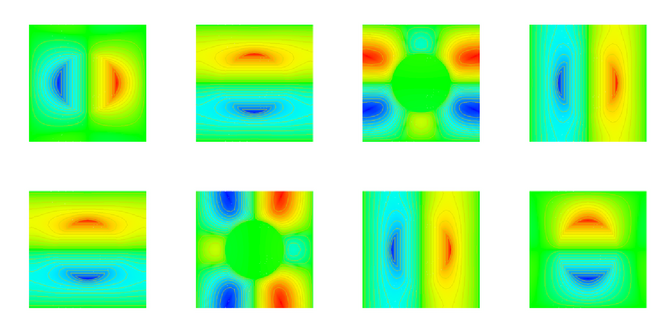
Assume that we have a two-dimensional elastic medium with periodically
distributed circular inlays consisting of a stiffer material. If these
holes are small then the medium will behave on a macroscopic scale like a
homogeneous medium without holes. The elasticity tensor of this medium can
be calculated as follows:
- On the representative cell compute a tensor N of rank 3 which correspond
to responses of the representative cell to different loads. Boundary
conditions for this problem are periodic.
- Compute the effective tensor by evaluating the load functionals on the
tensor N.
The picture above shows the 8 components of the tensor N for the 2D-case.
We used conforming finite elements of order 5 with nonlinear element
mappings to approximate the tensor N. Solver for the linear problems was a
W(1,1)-multigrid cycle with an overlapping block Gauss-Seidel smoother.
The history of this calculation was as follows (three of the 16 components
are shown, due to symmetry properties the remaining ones can be obtained by
a suitable permutation of indices):
| Cells |
Unknowns |
Matrix entries |
A1111 |
A1212 |
A1221 |
| 9 |
1800 |
43060 |
4.1458940638 |
1.3176717343 |
1.2966840277 |
| 36 |
7200 |
176224 |
4.1412496929 |
1.3139564023 |
1.2979726371 |
| 144 |
28800 |
705600 |
4.1412384319 |
1.3139473004 |
1.2979716831 |
| 576 |
115200 |
2822400 |
4.1412383854 |
1.3139472825 |
1.2979716903 |
| 2304 |
460800 |
11289600 |
4.1412383853 |
1.3139472825 |
1.2979716903 |
Nicolas Neuss, 2017-01-31